External Storage
High-Level Design
» Download this section as PDF (opens in a new tab/window)
High Level Design
When designing the external storage integration, an important goal was to make sure it requires minimal changes and modifications in the workflows and platform capabilities provided by Nutanix. The external storage integration still has a Nutanix cluster called Nutanix compute cluster or Nutanix Cloud Infrastructure (NCI) compute cluster. Unlike HCI, this cluster is created on boot devices or boot drives on the nodes. The nodes in the cluster are still created with a Controller Virtual Machine (CVM) acting as brains of the cluster with its various shared cluster services.
CVM in Compute Nodes
In a Nutanix compute cluster, the nodes still have a CVM that runs on every node just like in an HCI deployment. The difference with external storage integration compared to HCI is that the CVM does not manage any local disk drives.
Instead:
- The CVM boots from the host’s local boot device such as M.2 cards or BOSS cards.
- All persistent data for user VMs is stored on the external array.
- The CVM retains its role as the brains of the node and cluster, handling I/O orchestration, metadata management, networking, background operations and DR workflows.
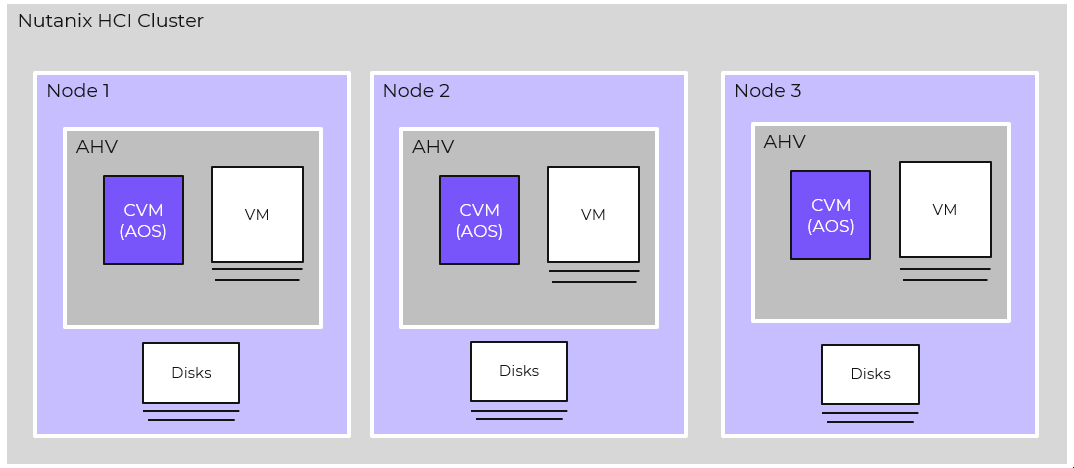 HCI Cluster
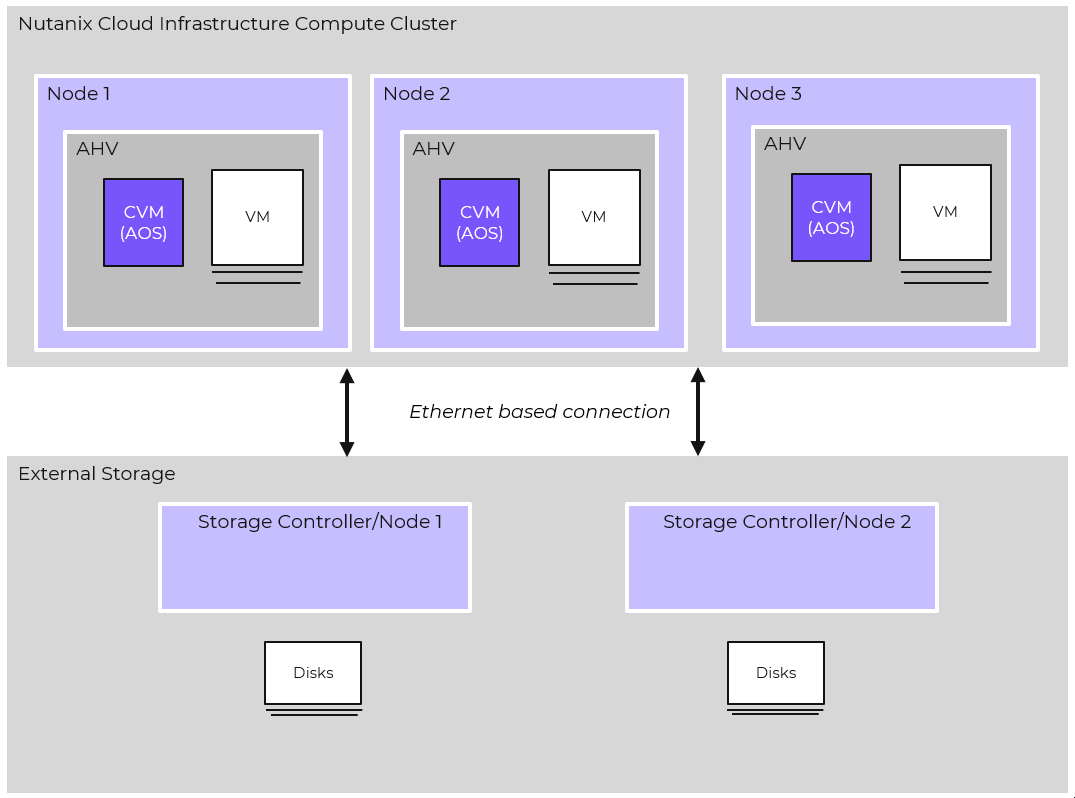 Nutanix Compute Cluster with External Storage
Design Choices
When architecting this integration, the engineers had to make some design choices with respect to the architecture and integration.
- Protocol Selection: When architecting the data path between the Nutanix compute cluster and external storage, the foundational decision revolved around the choice of transport protocol. Ethernet-based transport provides standards-based simplicity and frictionless deployment of the solution. This approach allows leveraging datacenter networking and avoids the complexity of specialized, legacy storage fabrics. While Ethernet provides the underlying foundation, the specific storage protocol is dynamically tailored to align natively with the target storage array:
- Dell PowerFlex: Utilizes a proprietary Ethernet-based protocol that uses Dell SDC(Storage Data Client) optimized for the PowerFlex architecture.
- Everpure and Dell PowerStore: Leverages NVMe/TCP to deliver highly parallelized, ultra-low latency block I/O over standard networks.
- NetApp: Will utilize NFSv3, capitalizing on its proven maturity and efficient file-based access.
- API-Driven Provisioning over Manual LUN Creation and Masking: Instead of provisioning individual LUNs on an array and manually mapping them to hosts, Nutanix integrates the storage vendor’s APIs directly into AOS and Prism. When a VM or vDisk is created in Prism, the control plane programmatically communicates with the external array to automatically provision and map the corresponding resources.
- 1:1 vDisk-to-Volume Mapping : To maintain Nutanix’s core tenet of VM-centric operations, the architecture enforces a granular mapping between a Nutanix virtual disk and a thin provisioned native volume on the external array. This 1:1 mapping bypasses the need for a complex file system layer on top of the external block device.
- Offloaded Data Services : Storage related features like compression, deduplication, and encryption are offloaded to the external array, leveraging the external array’s capability to provide those functionalities.
- Simplified Network and DR : Nutanix Flow Virtual Networking and Flow Network Security work the same leveraging the same CVM services, simplifying network management and security. Additionally, Nutanix Disaster Recovery continues to orchestrate snapshots and replication, leveraging snapshot capabilities of the external array via APIs, providing a consistent DR workflow the same way as HCI.
©2025 Nutanix, Inc. All rights reserved. Nutanix, the Nutanix logo and all Nutanix product and service names mentioned are registered trademarks or trademarks of Nutanix, Inc. in the United States and other countries. All other brand names mentioned are for identification purposes only and may be the trademarks of their respective holder(s).