» Download this section as PDF (opens in a new tab/window)
Today’s IT environments have fundamentally changed. Workloads are no longer confined to a single datacenter; they are distributed across multiple sites and clouds, in a truly hybrid and multicloud approach. This transformation brings agility and flexibility, but it also introduces new challenges. Operational silos complicate the management of multi-tenant infrastructures. Security must now extend across every layer, from the application to the network. Speed of execution is critical, as teams are expected to operate at cloud velocity without slowing down the business. Day-to-day operations are becoming increasingly complex, from deployments to migrations. Application mobility has also become an unavoidable reality, with workloads that must move freely between environments. In the face of this complexity, we must rethink how networks are designed, secured, and operated.
It is in this context that Software-Defined Networking (SDN) emerged. The core idea of SDN is to separate the control plane from the data plane, centralizing network intelligence while maintaining distributed execution at scale. SDN provided concrete answers to modern challenges by introducing programmability that replaces scattered manual configurations, automation that accelerates the delivery of network services, unified visibility that enables deeper understanding and protection of application flows, and abstraction that allows teams to operate at the level of business needs rather than IP addresses and VLANs. With SDN, the network becomes an agile service, aligned with the expectations of cloud and modern applications.
This is precisely where Nutanix Flow comes into play. By combining Flow Virtual Networking (FVN) and Flow Network Security (FNS), Flow provides an integrated approach to connectivity and security in Nutanix environments. FVN delivers the virtual networking infrastructure including VPCs, subnets, gateways, extensions, and hybrid interconnects. FNS brings distributed and stateful security controls natively embedded in the Nutanix hypervisor, AHV. Together, these components enable the design of agile, secure, and multicloud-ready architectures without unnecessary complexity or reliance on traditional appliances. Flow represents the vision of a network that is simple, elastic, and secure, built to support application mobility and continuous innovation. To begin this journey, we will first define what Flow is, why it was created, and how it fits into the broader Nutanix platform.
Flow Virtual Networking (FVN) and Flow Network Security (FNS) are two complementary components that work together to deliver and secure software-defined networks in a uniform way across the Nutanix hybrid multi-cloud landscape. They are designed with a simple but ambitious vision: to bring networking and security to the same level of simplicity and automation that Nutanix has achieved for compute and storage. Traditional networks are complex, rigid, and heavily dependent on specialized appliances. Flow removes this barrier by embedding networking and security directly into the Nutanix platform.
The value proposition of Flow rests on three pillars. First, it simplifies operations by providing a unified framework to manage both connectivity and security across virtualized environments. Second, it enables application-centric architectures where policies and connectivity follow workloads, regardless of where they are deployed. Third, it prepares enterprises for hybrid and multicloud realities, extending secure connectivity beyond the boundaries of a single datacenter. This design philosophy has resulted in a platform that enables customers to move faster, operate more securely, and reduce the operational overhead typically associated with networking and security infrastructure.
While FVN is focused on building and extending networks, FNS is focused on securing them. Together they form a complete solution for application connectivity and protection. FVN provides the constructs required to build modern virtual networks. It introduces VPCs, overlay subnets, gateways, VPN connectivity, BGP-based dynamic routing, and load balancing. These capabilities allow Nutanix environments to connect seamlessly to each other, to external datacenters, and to public cloud resources.
FNS delivers distributed, stateful firewalling natively on AHV hosts. It enforces microsegmentation policies between workloads and reduces lateral movement risks without requiring external firewalls for east-west traffic.
AHV leverages Open vSwitch (OVS) to present traditional VLAN networks, with each node running an instance of OVS via a default bridge, called br0. You must attach physical interfaces to br0 to act as uplinks, either as standalone uplinks, in active/passive or active/active aggregates. Additional bridges can be created as needed. An additional bridge, not managed by OVS, called virbr0, also exists to facilitate internal AOS networking.
Across all of the nodes in a cluster, the bridges are aggregated into a virtual switch. The default virtual switch is called vs0. To facilitate this, each host in the cluster must have identical uplink port configuration. The physical switch ports for each host should also be configured identically, presenting the same VLANs to each host’s uplinks.
Subnets are added to the virtual switch and defined by a VLAN tag. This makes the subnet available on every host’s bridge. VMs are connected to subnets, which connect by way of tap ports.
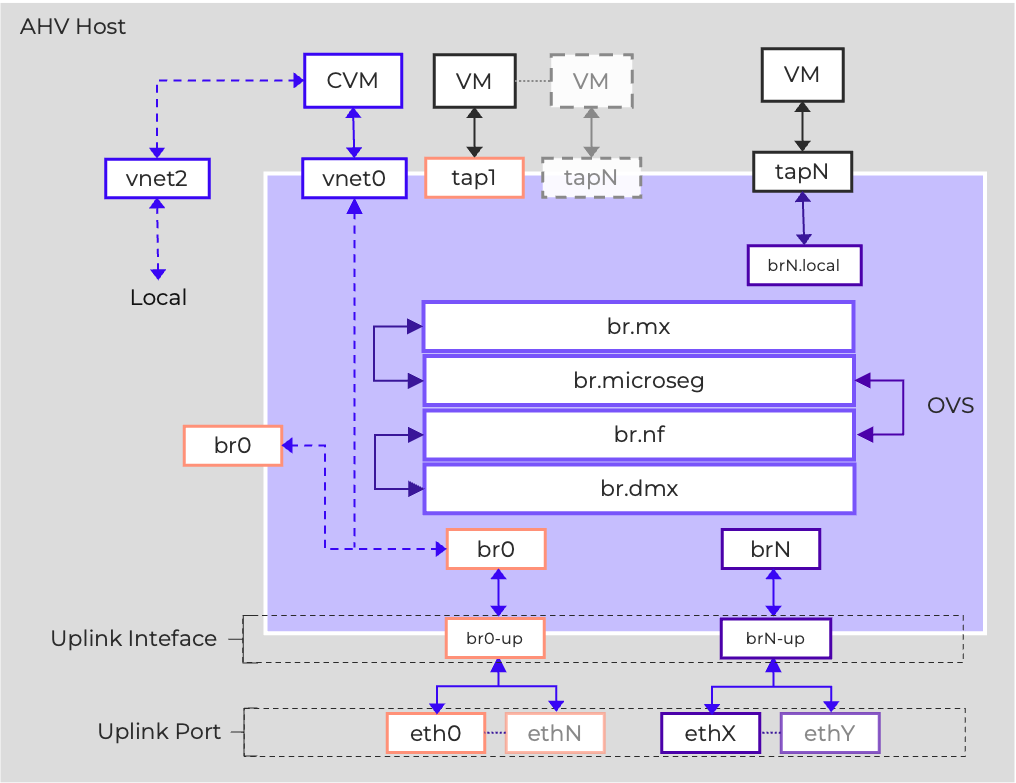
Nutanix Flow is implemented as extensions of the base AHV networking systems, so an understanding of that base networking is valuable in understanding the data plane.
Nutanix Flow is structured in a familiar three-plane architecture (Management, Control, Data) that enhances the OVS-based networking on the AHV hosts with added functionalities through the Open Virtual Network (OVN) project.
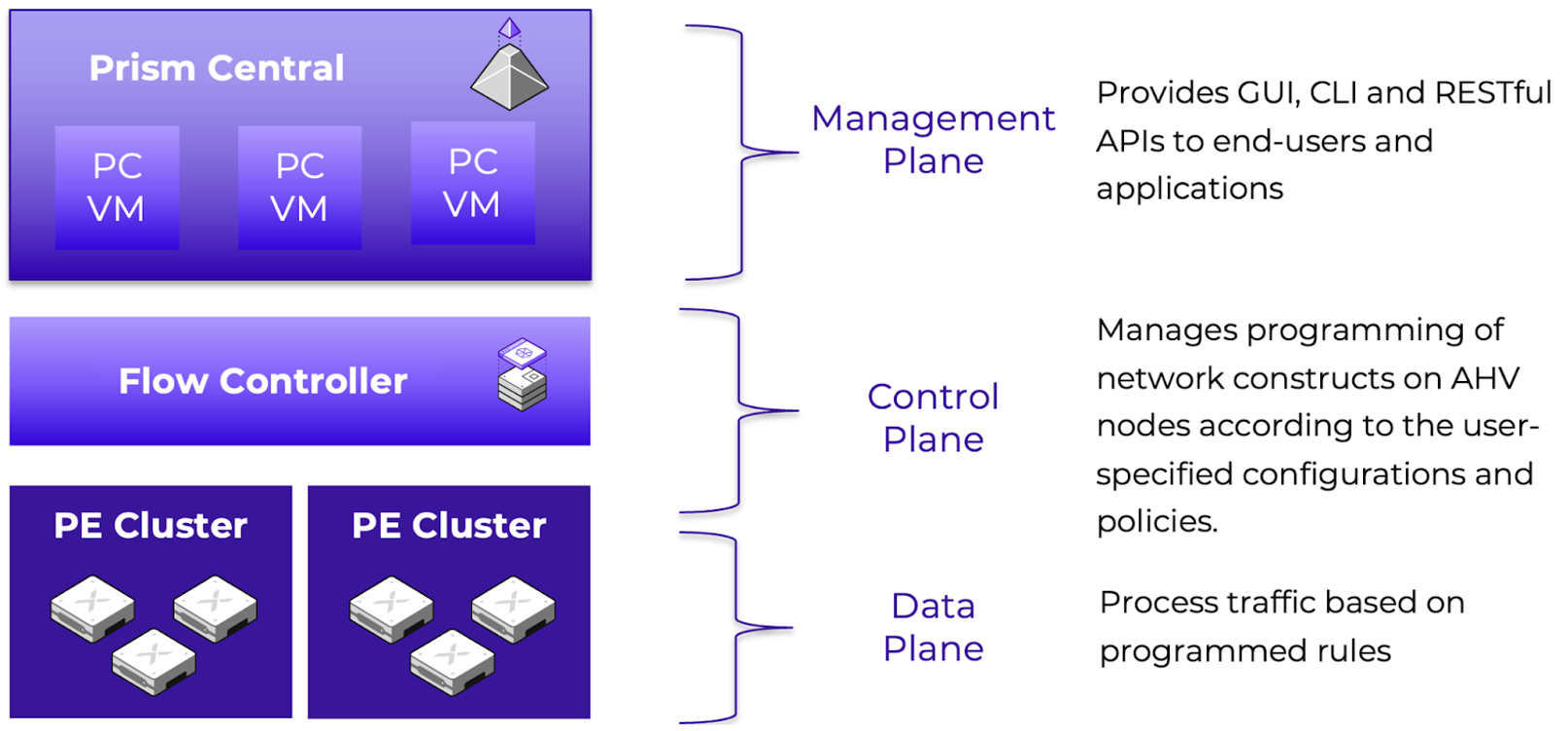
The Management Plane is delivered via Prism Central, the single management plane for Nutanix clusters, ensuring a consistent operational model for administrators. Prism Central provides GUI, API, and CLI interfaces for CRUD operations and monitoring. There are four primary services that work together to provide the management plane:
The Control Plane has a centralized component called the Flow Controller, formerly Network Controller, formerly Advanced Network Controller (ANC), as well as a distributed component that runs on each AHV host. The Flow Controller is delivered as a set of containerized services. You can deploy the Flow Controller in integrated mode which leverages the built-in Prism Central Container Microservices Platform (CMSP). Alternatively, standalone mode deploys the Flow Controller on SMSP (Services Microservices Platform) using three worker VMs and two load balancer VMs. The Flow Controller creates virtual overlay networks as an abstraction of the underlay (VLAN networks), managing network services.
The main services of the control plane include:
Hermes is the service that manages OVN configuration, receiving updates from Atlas and converting them to OVN logical configuration, and sending that configuration to the OVN components. Hermes also collects metrics from each AHV host’s OVS instance. Hermes consists of two sub-components: anc-hermes is the main service, and anc-mysql (MariaDB) stores the Hermes configuration. These service names reflect the prior Atlas Network Controller naming, ANC.
Open Virtual Network (OVN) is responsible for programming the data plane elements on the AHV hosts. OVN has centralized components hosted on the network controllers, and distributed components hosted on each AHV host. On the Network Controller, there are two main components: anc-ovn which runs the ovn-northd service as well as the OVN NorthboundDB and SouthboundDB, and anc-policydb which handles mapping connections to policies for visualizations and hitlogs. On each AHV host, the ovn-controller service is responsible for taking configuration from the OVN SouthboundDB and programming the data plane elements on the local hypervisor accordingly.
The Data Plane is fully distributed, allowing implementation of the network and security constructs across the AHV hypervisor nodes. This allows for an efficient, resilient environment that avoids bottlenecks and scales in capacity as clusters grow. It comprises the following parts:
This tight integration means that Flow is not an external add-on, but rather a native capability of the Nutanix Cloud Platform. Administrators can create VPCs, configure gateways, define security policies, and monitor traffic without leaving Prism Central. For customers, this results in a consistent operational experience across compute, storage, networking, and security.
In the following sections, we will discuss the specifics of the Flow Virtual Networking data plane implementation.
Nutanix Flow is able to deliver both functional multitenancy and administrative multitenancy through this three-plane architecture.
Functional tenancy defines whether the environment is logically partitioned to provide private network resources to disparate groups. These groups can be internal groups, such as departments, development teams, or business units. They can also be external groups, such as clients consuming resources from a service provider. Functional multitenancy in Flow is similarly implemented through the data plane implementation of Virtual Private Clouds, allowing individual groups to have their own networks as well as their own security policies.
Administrative tenancy defines whether administrative access and functions are made available to multiple groups to manage their own resources. This can also be internal, where RBAC is used to grant selective access to staff members via a single identity provider (IdP), or external, where multiple IdPs are configured, enabling external clients to access the environment. Administrative external multitenancy is typically only found in service provider environments. Prism Central enables administrative multitenancy through configuration of multiple identity providers and through assigning resources to Projects.
Nutanix Flow extends the capabilities of the Nutanix Cloud Platform, using the flexibility of Software Defined Networking to further existing capabilities. For example:
The following sections will cover these in more detail.
Navigate to Security Central under Cloud Management to find information on security planning, threat detection, and compliance monitoring.
©2025 Nutanix, Inc. All rights reserved. Nutanix, the Nutanix logo and all Nutanix product and service names mentioned are registered trademarks or trademarks of Nutanix, Inc. in the United States and other countries. All other brand names mentioned are for identification purposes only and may be the trademarks of their respective holder(s).